Tiger Temple, or
Wat Pha Luang Ta Bua, is a Buddhist temple in Western Thailand which keeps numerous animals, among them several tigers that walk around freely once a day a

nd can be petted by visitors.
The Theravada Buddhist temple is located in the Saiyok district of Thailand's Kanchanaburi province, not far from the border with Myanmar, some 38 km north-west of Kanchanaburi along the 323 highway. It was founded in 1994 as a forest temple and sanctuary for numerous wild animals. In 1995 it received the Golden Jubilee Buddha Image, made of 80 kilograms of gold.
According to the abbot and others associated with the temple, in 1999 the temple received the first tiger cub, it had been found by villagers and died soon after. The story goes that several tiger cubs were later given to the temple over time, typically when the mothers had been killed by poachers, others who wanted to get rid of their tiger "pets" or those were under pressure to do so as laws and policies surrounding the keeping of cites protected species became more strict. As of 2007, over 21 cubs have been born at the temple and the total number of tigers is about 12 adult tigers and 4 cubs.
The subspecies of these tigers is unknown as none of them have been DNA tested, but it is thought that they are Indochinese Tigers, except Mek (a Bengal Tiger). There is also a possibility that there may be some of the newly discovered Malayan Tigers and it is likely that many are cross breeds or hybrids.
They spend most of the time in cages, being fed with cooked chicken, beef and dry cat food. The meat is boiled to avoid giving the tigers a taste for blood and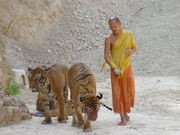 also to kill the bird flu that may be present in raw fowl. According to the temple website the dry cat food replaces nutrients, such as taurine, that are lost when the meat is cooked.
They are washed and handled by Thai monks, as well as local staff, and international volunteers. Once a day they are walked on leashes to a nearby quarry. Originally they would roam around freely in this area but now, with the increase in visitors and the amount of tigers who sit in the canyon, are chained. The staff closely guide visitors as they greet, sit with, and pet the cats. The staff keep the tigers under control and the abbot will intervene if the tiger gets agitated. Nervous tourists may also observe this from about 10 metres away. The temple collects donations for feeding and upkeep, and to fund the building of a larger tiger sanctuary which would allow the animals to live in an almost natural environment all day long.
The Tiger Temple practices a different conservation philosophy than in the west. In western zoos and parks the emphasis is on providing a natural environment for the animals. In the temple, at least until the sanctuary is completed, the animals seem to be treated more as family members. Although it may be possible for the offspring of the current generation to return to the wild, their parents will live out a life within the temple grounds. Their conservation philosophy seems to be working, while projects elsewhere often need to resort to artificial insemination over 10 cubs have been born at the temple in the last three years despite having no breeding program whatsoeve r.
The temple opens daily for visitors at about 1pm, and the tigers are walked back to their enclosures at around 4pm. Due to the pressing need for income, the temple now charges 300 Baht admission. The most common way of visiting the temple is to go on a tour from nearby Kanchanaburi for 300 Baht per head, or to hire your own Songthaew from the bus station for a group for less than 1000 Baht. Day trips are also available from Bangkok. Prices current as of July 2006 and do not include temple entrance fee. The temple now receives 300 to 600 visitors a day. There are donations boxes in various locations around the temple for those who wish to support the sanctuary. To get photos with the tigers, visitors are asked to give a donation.

 orcycle race course. It is situated on State Highway 36 (Pattaya-Rayong) about 15 kilometers from Pattaya City. Races take place regularly on Saturdays and Sundays.
 mately 5 kilometers to the South o Patlaya. Separate tracks have been allotted for professional and amateur drivers. Open daily from 10a.rn.-7p.rn Tel: (038) 422044.


